
Understanding Intake, Screening, and Diagnosis: Key Distinctions and Processes

When you decide to seek clinical or educational services for your child or mental health support for yourself at Seed Connections, knowing what to expect can ease any uncertainty.
The intake process is the first step in understanding your needs and planning the best path forward. Depending on your needs, this may be followed by screening, and if necessary, clinical assessment and diagnosis. If required, intervention will be recommended.
This post explains the intake session, screening, diagnosis, and how interventions are recommended, helping you feel confident and prepared.
1. About Intake Session
The intake session is the first appointment, lasting about 60 to 90 minutes. It serves as an opportunity for the practitioner to learn about the client and evaluate the best way to help.
The purpose of the intake session is to assess whether the client needs screening or formal assessment and diagnosis.
What is Involved in Intake Session?
For child clients, the intake session involves:
1.Verbal Interview with Parent(s)
The practitioner asks questions to understand the child’s background, including home environment, schooling, and any concerns parents have noticed.
2.Child Interview or Observation
The practitioner interacts directly with the child. This may include play-based observation, where the child’s behavior and responses during play are noted.
3.Feedback and Recommendations with Parent(s)
After gathering information, the practitioner shares initial impressions and discusses possible recommendations and next steps. This is also a consultation session for parents to discuss and bring up their concerns, and collaboratively work and agree on the best way forward and intervention plans.

For non-child clients, the intake session usually consists of a structured verbal interview where guided questions will be asked to understand your background, concerns, and goals. A clear, professional understanding of your situation will allow the therapist to analyze and plan the most effective approach for your therapy. It ensures that therapy takes the right direction.
Preparing for Your Intake Session
To make the most of your intake session, consider:
Bringing any relevant reports or previous assessments
Writing down your main concerns and questions
Being ready to share about daily routines, challenges, and strengths
This preparation helps the practitioner understand your situation fully and tailor their approach.

2. Screening and Clinical Assessment
After the intake session, the practitioner may recommend screening or a formal clinical assessment if needed.
a) Screening
This is a brief process to identify specific areas of concern. It helps determine if a more detailed assessment is necessary. It is less comprehensive than a clinical assessment (which may lead to a diagnosis).
For child clients, screening involves screening tools like the CBCL which screens for emotional and behavioral issues in children and the DP-4 which screens for developmental delays and strengths in children. These tools are usually filled in by both a parent and teacher.
Low risk - If the screening determines the client to be at lower risk, the practitioner will give their recommendation for the next steps. For child clients, the practitioner may recommend enrichment classes, such as phonics classes for children who struggle with reading and writing, or request the parents to observe and track their child’s progress before taking further action.
High risk - If the screening determines the client to be at risk, the practitioner may recommend a clinical assessment, an intervention, or both.
b) Clinical/ Educational Assessment and Diagnosis
If screening suggests the need, a thorough clinical assessment follows.
A clinical or educational assessment is a process of thorough testing for suspected conditions. During an assessment, a clinical psychologist or educational psychologist uses a set of validated assessment tools. The assessment may result in a diagnosis; although certain conditions, such as autism spectrum syndrome, may take longer to diagnose.
When Clinical/ Educational Assessment and Diagnosis Needed?
Generally clinical or educational assessments are needed for professionals to know how to work with clients for intervention. Here are some situations in which a clinical/educational assessment could be considered:
Intervention planning: A diagnosis may help the practitioner design a more effective intervention plan.
Third-party referral: A third-party such as a school, pediatrician, or psychiatrist may request that the client get an assessment. In some cases, the screening process may be skipped.
Educational or workplace accommodations: An assessment and diagnosis may be needed for the client to qualify for special education services, individualised education programs (IEP), or disability accommodations.
Legal or court-ordered evaluation: A clinical assessment may be requested for legal cases.
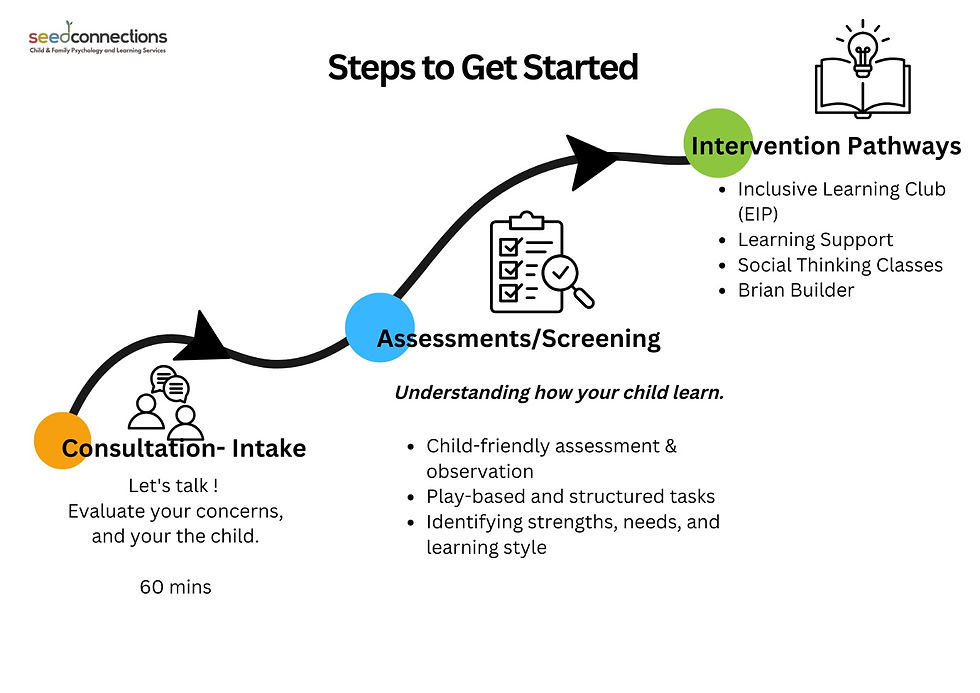
Ready to Take the Next Step?
At Seed Connections, we understand that seeking support, whether for your child or yourself can feel overwhelming. Our experienced practitioners are here to guide you through the intake, screening, and assessment process, ensuring that every step is clear and supportive.
For the time-being, you can explore our child intervention and adult intervention services, ensuring a clear, supportive path forward for growth and mental health.
WhatsApp us today at (+60 17-277 6605) to learn more or schedule your intake session and start your journey toward meaningful support and growth!


Comments